Showing posts with label Damascus. Show all posts

Wednesday, May 16, 2007

History throughout photographs

I Got this Photographs through email and i think its worth sharing
The Syrian University in 1925.
The Marjeh Square in downtown Damascus before World War I. In 1911, the monument in the middle was erected, and in 1916, Marjeh became a historic landmark when the Ottoman Turks executed 21 Arab nationalists there for defying the Ottoman Empire.
The Hijaz Railway Station in Damascus during World War I. The station was not build until after 1912 but the Damascus-Medina railroad had been created in 1908. The Hijaz Station has been designed by the Spanish architect Fernando de Aranda, who combined Western and Oriental elements. The building is still considered one of the most beautiful in Syria.
The Hamidiyyeh Market in Old Damascus in 1890, named after Sultan Abdulhamid II.
The Rabwa Road in Damascus during the early 1920s.
The Salhiyyieh Street in downtown Damascus during the Ottoman Era.

A barber shop in old Damascus. This picture was taken in 1900.
General Yusuf al-Azma (1883-1920), the Minister of War and Chief-of-Staff under King Faysal in 1918-1920.
A photograph of an American tourist in Syria in 1870. The American Flag is hoisted over his caravan.
Syrian coins during the era of King Faysal I (1918-1920).
The Azm Palace in Damascus, set ablaze by the French air raid on October 18, 1925.


New 08-2005: Syrian schoolchildren in New York during World War I, in 1914.
Students rioting at Damascus University in 1925.
Medical students at Damascus University in the 1920s.
The Ottoman Army led by pipers marching through Damascus on July 23,1917 as part of the Ottoman-German alliance during World War I.

A Syrian shop on Washington street in New York City in August 1920. The picture shows the Syrian shop owners selling "maarouk," a local bread usually popular during Ramdan
to Syrian and American customers.


Wednesday, July 05, 2006

Jazz Fever in Damascus


On the 2nd of July Damascus hosted the opening of the Jazz Festival
the concerts will be held until the 6th day of July at 8 p.m., 5 days of Live Jazz Music at the newly renovated Citadel Of Damascus.

The words of the Swiss Ambassador, Jack Dovatvil, at the opening night gave a Brief spotlight and tried to emphasize that the primary goal of the festival is the dialogue of cultures and to present jazz as a factor in disseminating humanitarian values in the world and not the conation of showing the skills of foreign players, or even locals, and that The diversity of performance will allow the public to discover new horizons of music in every evening.

the Swiss Syrian Jazz orchestra is considered to be the only one in the Middle east
And its music is wrote and composed by many well known composers all over the world
Like Frank Kalberg (Finland) Amadis Duncal and Oliver Verdle (Switzerland), and Allen Johnson (US). The Jazz Orchestra( The big band) consists of 42 musicians divided between Syrians and Swiss members.

Further more what was so interesting was the use of the Oriental Instrument ( Qanoon) in some of the music peaces they played. So the mix of the eastern and oriental Music was just amazing… for all Jazz fans in Damascus u still got 2 days to go so don’t lose the opportunity because I guaranty you’ll have one heck of a time .

Saturday, June 17, 2006

The Zahiriyya Library


Al-Madrasa al-Zahiriyya was originally a residential home that was transformed to a madrasa in 1277 after the death of Mamluk ruler Al-Zahir Rukn al-din Baybars al-Bunduqdari, or Baybars I (1260-1277), who is famous for the conquest of most of the Levant from the Crusaders. The king was buried in an elaborate mausoleum with a high dome in the southwest corner of the building.


The history of the building, which dates from the late 13th century, is probably more interesting than the holdings of the library itself. One of the largest and best preserved of the Damascene madrasas, al-Zahiriyya was named for Sultan al-Zahir Baybars, the first of the Mamluks sultans. In 1876 it was turned into a general library. Along with al-'Adiliyya Madrasa, across the street, it was also headquarters of al-Majma' al-'Ilmi al-'Arabi, the premier institution of the Syrian literary renaissance of the late 19th and early 20th centuries.


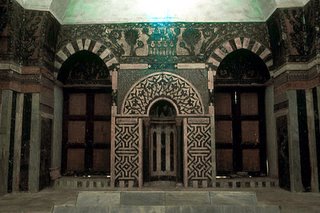
The madrasa is richly decorated using various materials and techniques. The main entrance gate is semi-domed with stone muqarnas. The interior ornamental program consists of marble revetment, carved stucco, gilt wood and a continuous frieze of glass mosaic that depicts architectural ensembles on three of the four interior walls, along with vases, trees, and other stylized vegetal motifs. The mihrab in the mausoleum is made of colored marble to allude to patterns and mosaics typical of the Mamluk architectural style.
the name of the mausoleum's architect, Ibrahim b. Ghana'im, is carved into the muqarnas hood of the monumental entrance portal.


The Zahiriyya collection was decimated, however, by the creation of the Asad Library when the manuscript collection, rare books and periodicals relating to Syria were transferred to the Asad Library. The Zahiriyya now contains about 70,000 volumes mostly related to Islam, the Arabic language, history and biography. The library is now used mostly by high school and college students.

I have lots of memories in that Library for I spent many times studying there with friends and I just love it :)


Sources from
Middle East Studies Association Bulletin

Wednesday, May 24, 2006

Gates of Damascus

Damascus is considered the oldest inhabited city in the world . And it was orderly constructed from its early historical beginning .

The wall of Damascus was built in the Roman period with huge rounded rocks and stones and was provided with seven gates and a paved network of roads that comes out of this gates in different ways


The only intact part of the wall stretches from Bab Assalam to Bab Toma ( 500 meters). But most of the gates are still intact with slight changes in their original marks. Other gates were installed in the Islamic era such as Bab Assalam and Bab Al-Faraj. Some of the towers of the wall are still intact such as Nour Eddin tower, South of Bab Al-jabieh, and Salhieh tower, east of Bab Toma.


And the seven gates of Damascus are:
Three settled in the northern side

Thomas Gate (bab toma): the name of the gate is related to one of Roma’s known great fi
gures and his name was Thomas, and it’s mentioned that Amr Ebn Alas entered Damascus from this gate the day Damascus was conquest


Peace gate (Bab Asslam) : its next to Thomas gate to the west and it was takedown and rebuild in the time of Nour al Din Mahmod where he build a minaret over it. And it was called that way because the warriors entered it hardly.


Paradise Gate (Bab Al Faradis) : it was named that way because in the Roman era it was surrounded by many groves and water and it was innovated in the time of King Al Saleh Ismail


From the south side there’s two gates:

Bab Kissan : and it is located to the South near Al Baytara Square, and in the Byzantine era a church was build there and it became the entrance to the Church. And the name is related to Kissan the guardian of the Caliph Mo’awia that revealed to him during the Islamic conquest.


The small Gate ( bab al sagher): it is located in northern eastern the city near to Shahgor now. And it was named that way because it is the smallest of all gates and Yazid ben abi sufian entered Damascus through this gate while the conquest of the city, and also Tamurlane in 14oo A.D.


And in the east there’s one Gate:

The eastern Gate (Bab Sharki) : and it was named according to the location of the gate in the east of the city. This gate is formed of three vents in the form of arches the biggest vent is the one in the middle and behind it there’s a straight street while the other 2 vents behind them there is small hallways located on the two sides of the street and carried by columns. the Islamic warrior Khaled ebn al waleed entered the city through this gate and also the Abbasid commander abed allah ben ali in the year 749 A.D.


And in the west side there is a gate

Bab Al jabieh: and it faces the eastern gate and also has the same structure. And the name of the gate is related to Al Jabieh village because they used to pass out of it when going to that village. Obayda Ben Al Jarah entered Damascus through this Gate. And this gate has a great memorial when Mosa Ben Nassir entered Damascus with a great pageant in the year 714 A.D.

The eastern gate and Al Jabieh gate enclose between them a straight street that includes arches of triumph


In addition to the seven main gates of Damascus there’s other gates less important and they are:

Bab al Faraj: situated to the south of Damascus between Asroniah and Manakhiah and it had two function the 1st is misleading the enemies and the 2nd was economic.

Bab Al Naser ( victory Gate) : situated in the entrance of AL Hamediah Market and it was demolished in the Abbasid era.

The quarters of Damascus was well bulwarked behind those Gates and some of those Quarters had its own gates like Bab Srejah, bab Mosalah , bab Maser


Those are the Main and the subordinate gates of Damascus and every stone of it tells us the Story of an eternal City through ages


Wednesday, March 29, 2006

Well quite a few people who’ve been visiting my blog asked what exactly my blog is about…and I my self haven’t write an introduction to it. And the title of the blog seemed so strapping and determined…

So I thought to write a post about it
Well my simple humble blog is about me, my home town Damascus, my Syria, my thoughts, my dreams, my poems, my stories, my pics, places that I’ve been to…etc
And yes I am Syrian to the bone and proud of it…and the that title wont stop me of publishing anything that I want beside writing about Syria.

So the thoughts and posts that are and will be published here will be pure Syrian to the bone thoughts and ideas…hope I made up my point and u got what’s my blog is about.

For any ideas suggestions or questions don’t hesitate to drop me an e-mail


Sunday, February 19, 2006

About My Beloved Damascus

A modern capital whose voice - discreet but assured is having a decisive effect on the Arab world and in the Mediterranean area today.Damascus is said by its citizens to be "the oldest continuously inhabited city in the world".One other Syrian city, Aleppo, disputes this title. However, recent excavations have shown that it is the Hama region (the Orontes al Lattamne basin) which really deserves it.

Omayyad Mosque - At the heart of Damascus The Mamluk minaret framed between two Corinthian columns dating from fourteen centuries earlier, symbolizes the extraordinary mixture of influences that have gone to make up this city of nearly three million five hundred thousand people.
The Omayyad dynasty made Damascus the political, religious and cultural center of early Islam; but the built by Caliph Al Walid (705-715) included within its walls a church which had itself been built on the site of the temple of the god Hadad The Arameans. Salah al Din, the hero of Islam, lies buried in this city which the Crusaders were never able to invest; and it was not far from here that Paul of Tartous was converted.

Damascus is mentioned in the earliest historic texts - Egyptian records of the 19th century B.C. and the archives of Mari, dating from the 25th century B.C.
Further back, history gives way to legend and speaks of "Dimashq al Sham". Legend too, gives way to poetry, in which it is said that when Christ returns to Earth to do battle with the Anti-Christ, he will make his way down by the highest minaret of the Omayyad Mosque.
The oldest city in the world?… To be sure, but is it not so because the secret of longevity is change, and because timelessness can only be achieved through evolution?
No matter
what his route, the visitor is struck by much that is new in Damascus. Arriving from the International Airport he sees many recent technical installations , ultra modern hotels, and the improvement of the arid zones on the edge of the desert.
If he comes by motorway - from Homs, Hama or Aleppo, he sees a vast new industrial area, wide avenues and clear-ways right to the heart of the city. Coming from Beirut he passes the University Residence, the extensive duty-free zone, the International fair with its great concrete arrow, the handle of which symbolizes the Damascus sword. If he comes in from Qunaytra he sees a satellite-city under construction - Dimashq ad-Jadideh, New Damascus.
There is also the new mountain road, leading into the city from the north after having climbed almost to the summit of the Jabal Qassiun; it offers a splendid panoramic view of Damascus and the green slopes around it. Other features include the three sports complexes, finished in 1976 to receive the Arab Olympic games.

Finally, the city center is being restructured to cope with heavy traffic and to provide the business premises, offices, hotels and administrative buildings that are urgently needed.


A sea of cars and people


Early in the morning , and above all in the evenings, the old city and the central quarters overflow with a human tide that surges from the pavements into the roadways, causing furious hooting from the motorists and vain shouting from the traffic police. Chains and protective barriers would seem to have been devised merely to serve as a training ground of obstacle racing… Very often the tide loses momentum and people drop out to stand in bus queues, to stop at the news vendors’ stalls, and to stand around in little groups and discuss the news in front of "super palatial" cinemas with advertisements all over them…
If the peddlers’ trays - laden with gewgaws, edible seeds and cigarettes sold individually - rarely attract the attention of the passers by, the same cannot be said of the shop-windows crammed with transistor r
adios, tape-recorders and, the latest craze, cassettes.
Garlands of oranges and lemons, great glass jars misted over from the ice-cold juices they contain, proclaim the narrow shop where you need little encouragement to buy freshly-squeezed fruit juices. In the neighboring roast-meat shop they tend to prefer a modern automatic spit that can take fifty or a hundred chickens at a time, to the traditional kebab skewers and the vertical "Shawarma" introduced by the Ottomans. And there behind the window stands a man with a big knife who, quick as a flash, will cut you one, two or ten slices from an apricot and semolina cake as big as a millstone…
Vanishing turbans and fezzes The crowds are dense, but peaceable; even the children rarely get excited. The people are pleasant, courteous and helpful when necessary, but rarely demonstrative or spontaneously familiar. A stranger in their midst does not arouse excessive curiosity; they show a reserve that it would be wrong to interpret as indifference - being more often the result of the difficulty of communication.
Dress is also a cause of astonishment to the foreigner encountering an anonymous crowd here for the first time.
The galabiehs, the turbans and the fezzes, that used to be worn, are being rapidly replaced by somewhat dreary European clothes. Even the "Kufiyeh", the headdress consistin
g of a piece of red or black check toweling held in place by a pit - so practical for desert travel - is seldom seen. In the general monotony the occasional sheikh’s turban, or the soutane of an Orthodox priest, stands out.


Fortunately the younger generation of Damascus women have the secret of blending simplicity with elegance - consigning the black veil, worn closed like a monk’s hood, to folklore.


Wednesday, February 15, 2006

أريج الياسمين يحكي تاريخ دمشق


تزهو دمشق ببيوتها القديمة ويقال أن أريج ياسمينها يسامر النجوم في ليالي الصيف ولكن هذا الجزء من تاريخ المدينة يكابد الهموم اليوم.تلك الوردة البيضاء الصغيرة استطاعت أن تقاوم عوامل الزمن الذي استطاع أن يأتي على جزء كبير مما يحميها من جدران تلك البيوت الأثرية التي سجلت لدى اليونسكو وأصبحت جزءا من التراث العالمي. الزمن ترك المدينة وبيوتها تشكو نقص الموارد المالية اللازمة لترميمها الياسمين هو أحد أهم خصائص البيوت في الجزء الأثري من مدينة دمشق التي تغنى بها الشعراء العرب وبينما يعيش الياسمين على القليل من الماء يغطي الغبار الزخارف والتصميمات الهندسية التي تعود إلى عود عربية أموية أو مملوكية وعثمانية أو تصميمات أوروبية تم استقدامها لتزين بيوت دمشق التي كانت إحدى المدن التي احتضنت عاصمة الخلافة الإسلامية وتزخر دمشق القديمة بالقصص الفريدة حيث عاش في أحد بيوتها قادة ومشاهير مثل قائد الثورة الجزائرية الأمير عبد القادر الجزائري وجين ديبكي سلسلة النبلاء الإنكليز التي تزوجت شيخ قبيلة بدوي وأمضت بقية حياتها في دمشق القديمة وأدخلت إلى مجموعة الزهور التي تزرع فيها الزهرة التي يسميها
الدمشقيون بالماغنوليا
ويقول رائد جبري أنه عمل بجهد على تحقيق حلمه بإحياء بيت جده الذي بني في العام 1737 وأقام فيه ملك العراق فيصل واجتمع فيه
مناهضو الانتداب الفرنسي القرن الماضي وقال جبري أن التكلفة التقديرية لبيت بحجم بيتهم الذي تقدر مساحته بحوالي 1200 متر مربع حوالي 30 مليون ليرة سورية (600 ألف دولار) ولكنه قرر أن يستثمر البيت كمقهى ومركز لعرض الأعمال الفنية والإنترنت والندوات
الثقافية لتغطية تكلفة ترميمه
وتبنى البيوت الدمشقية جميعها على نفس المبدأ حيث يقع الإيوان وهي غرفة للجلوس في الجهة الجنوبية والى جانبيه غرفتان تدعيان البراني وهو أقرب إلى الباب الخارجي لاستقبال الضيوف والجواني للجلوس والمنامة بالإضافة إلى ملاحق الدار. أما باحة الدار الداخلية فتتوسطها بركة ماء بينما تزين أشجار وأزهار أهمها الياسمين والوردة الشامية الحمراء الجدران المحيطة وتطل عليها شبابيك ومشربيات خشبية بزخارف متنوعة. وتبنى البيوت عامة من طابقين ولكن مساحاتها تتفاوت كثيراً من بيوت كبيرة ومتوسطة وأشبه بالقصور مثل قصر العظم ومكتب عنبر الذي يسمى الآن بقصر الثقافة وهما من ممتلكات الدولة السورية وهما مفتوحان للعامة. ومن الزخارف التي تزين الجدران ما يدعى بالأبلق والأملق وهي أحجار محفورة وفق خطوط هندسية مغطاة بطين ملون بينما يلبس السقف بما يسمى بالعجمي وهو خشب جوز نقع في الماء والكلس لمدة ثماني سنوات ونشف لمدة أربع سنوات قبل الشروع بزخرفته. وثمة أنماط أخرى للزخرفة كالأوروبي الذي يتمثل بحجارة الرخام تزينها رسومات دقيقة كأغصان الأشجار. وتضم دمشق القديمة حوالي 6000 منزل بالإضافة إلى الجوامع والكنائس
والحمامات الأثرية
ويقول نعيم ضابطة المسؤول عن دائرة لجنة حماية دمشق القديمة أن جهود محافظة مدينة دمشق
تنصب الآن على الحفاظ على مدينة دمشق القديمة وتحسين البنى التحتية من المياه والكهرباء والهاتف وترميم الواجهات. وقال: "نحن نريد أن تعيش المدينة كما هي بأهلها وسكانها ومرافقها ولا نريدها أن تتحول إلى منطقة سياحية خاصة للمطاعم فقط. لا نريدها أن تبقى بدون حياة خلال النهار"

Saturday, February 11, 2006

The Meaning of Damascus


Controversial explanations have been made to guess etymological origin of the name of the Syrian capital city. Some hold that “damashaq” means the fast-moving camel and the name was given because the building of the city was completed swiftly. Others believe it was named after Damashaq the great grandson of Sam son of Noah,who built the city.Still others presume that the Romans called it “Dumuskus” which means the double musk.Or perhaps the name was taken from Hermes son in Greek mythology who came over to Syria. In Aramean the name might have been derived from Dermask or dersauk as (E deim) means land and (mask) means (red) in Syriac.Whatever the etymological origion of the word, Damascus remains, as ever (the eye of the whole east) as the Rooman Julianus described the greatness of the city.Under the Roman it was a chief town, and later the fortress of bilad-U-Sham, and the passage to Mecca, the pavilion of all Muslims and God’s paradise on earth have never seen anything so extensive as its orchard, so good as its fruits and so plentiful as its water.It is said the water is so abundant that a fountain can be found in every house.Some historical sources say that the name of Damashaq (Damascus) is derived from the Aramaic word (dam shaq) which means a town built on the rock where the blood of Mash, the fourth son of Aram Bin Sam Bin Noah,flowed soon after a heavy blow by his brother Aws deeply cut Mash’s head.The fight between the two brothers broke out when they could not come into agreement on the name of the new town, some historians had different illustrations with regard to the name of (Dimashaq).The old city of Damascus still preserve its graphical and historical aspects,the high wall which protects the old city of Damascus is crystal clear until today.The citadel was built during the Seljuk rule, and rebuilt during Saladdin rule.It occupies an area of land estimated 220*190 square meters.It has 13 towers. Nur Eddin tower in the south west part of the wall, was built in 1168 A.D.Al-saleh Ayoub tower was built in 1248 A.D.There are seven gates, some of the gates date back to the roman era. Bab Touma and Bab Sharqi are perhaps the most oldest and famous gates of the old city of Damascus.Damascus museum, souk Al-Hamidieh and several other souks, palaces, Khans, and oldschools and Bimarestans are additional attraction in the old city of Damascus.

Traditional Damascene wedding

It is necessary to know the procedure which goes on before the actual wedding takes place.The business of match-making need to be, and still conducted by mothers in some parts of Damascus. Mothers and sisters assume the responsibility of finding suitable bride for their sons and brothers. All the prospective husband has to do is to name the specifications of the prospective bride, and he is sure to get one that answers to there specifications.The female match-makers conduct exploratory missions among relatives, neighbors and acquaint, and report to the anxious would-be bride grooms, who consider the pros and cons of prospective candidates. The type of information submitted for his consideration relates to the physical properties such as figure, color of skin, eyes and hair, shape, colors of eyes, mouth, teeth, nose, etc.; and to the social and financial status.Modern standards of evaluation consider such methods inadequate at first sight. Yet the various kinds of tricks and devices old females use to gain access information are surprising. Thus it is common practice for such females to surprise the bride before she has time to dress up and appear at her best. More over they make a point of kissing the bride in order to make sure that she has no bad breath or perspiration odors, some of them even arrange a seemingly coincidental visit to the public bath frequented by the bride and her family, in order to have a closer look at her.In addition to first hand information secondary sources are made use of. Those are found among neighbors and acquaintance of the future brides, who are usually only too willing to provide all sorts of information, relating to the girl's social and domestic qualities. Recently, a revolutionary method has bee introduced. Some people manage to obtain by fair or devious means, a photo of the bride to show to the man. This, it should be pointed out, was possible only among progressive families, that tolerate a picture of their daughter to be taken, provided the girl has scarf on her head to cover her hair.When all these operations are over, the prospective husband has to weigh the evidence presented to him, analyzes it, and scrutinize it, before he comes to an important decision, that of settling for wife. Then, another important step follows: negotiations relating to the dowry; the advance dowry which is to be paid and the late dowry which is to be paid in case of divorce.Negotiations concerning dowry are done be men: the father or the senior member of the bridegroom's family visit the father of the bride and officially proposes, or ask for the hand of the bride as they say in Arabic. Such negotiations are considered to be embarrassing. But fortunately, clichés and stereotyped expressions have been developed throughout the years and are used on such occasions. The bridegrooms, father would have learned the words he has to say, which run something like this: "We have come to be honored by asking the hand of your jewel of a daughter".The bride's father also knows the right words to say in reply something like this: "I offer you my daughter as a slave in your kitchen". This formalities and ceremonies completed, the actual hard bargaining takes place, at the end of which the amount of the dowry is fixed and the date of the wedding is set. The money paid by the bridegroom is spent on clothing for the bride, on furnishing a reception room, and on providing mattresses, pillows and sheets, and as a must. Pajamas a dressing gown and a pair of slippers for the bridegroom.The wedding takes place at the bridegroom's house. Only women are invited to the wedding. The bridegroom's guests come directly to his place first, and are then escorted to the weeding by a delegation comprising the senior female members of the bridegroom's family, who are sent to escort the bride, her family and her guests to the wedding, the delegation to provide the means of transport, formerly horse drawn carriages, and recently motor-cars.When the bridal procession arrives, the bride is received with cheers and songs, and is led to an elevated canopy but not before she sticks a piece of yeast on the door of the house, as a good omen. As she walks towards her appointed place, sugar coated almonds are sprinkled over her head and guests rush to pick-up as many as they can get held of. The procession stars from the house of one of the bridegroom's friends, where the pre wedding ceremony of the bridegroom's hair cut and dressing up is attended to by his friends and relatives, amidst cheers, reveling and dancing.On the arrival of the bridegroom, which is announced by a special messenger, the bride is supposed to proceed to the center of the courtyard of the house to meet him. The center of the house is a compromise position, compromise being reached after the bridegroom's family insisting on the bride not proceeding more than a few steps.The bridegroom the leads the bride to the elevated canopy, which is surrounded by relatives and guests. Before he sits next to her he takes out of his pocket a bracelet of a necklace, amidst cheers and rejoicing and presents it to her. This is followed by music and dancing, provided by professional group, if the family is well to do, or by amateur friends and relatives, if the family is not so rich. Singing and dancing last till after midnight, punctuated by intervals during which the pride-retries to change her white wedding dress and put on dresses of various colors.After midnight the bridegroom makes a move to withdraw with his bride but he meets with opposition on every side. After many resisted attempts, he manages to lead the bride to the bridle chamber, followed by female members of the family, who start offering their presents, usually in the form of gold sovereigns. The presents ceremony over, the family leaves the couple to themselves and continue the wedding celebrations until dawn.


Graduation paper 1998